

All stormwater treatment assets require maintenance to ensure ongoing operation, longer lifecycles, and regulatory compliance. The Atlan Floating Treatment Wetland (FTW) system requires minimal maintenance to ensure its long-term effectiveness, but these activities are critical to complete regularly.
Floating Wetlands are systems that use biomimicry to establish ecosystems that mirror natural floating islands. They provide growth for a range of wetland vegetation, which provides habitat for local wildlife, and improves water quality by suspending plant roots down into the water column.
Maintaining these systems is imperative to their performance and service life. Issues in FTWs can include inhibited plant growth, weeds, algae bloom, sediment blockage, and vegetation. Maintenance tasks for FTWs include –
- Vegetation management
- Floating unit inspection
- Debris and rubbish removal
- Water quality monitoring
- Sediment management
- Erosion control
- Wildlife management
- Planning and reporting
- Seasonal preparations
- Community and aesthetic management
- Algae bloom control
- Weed control
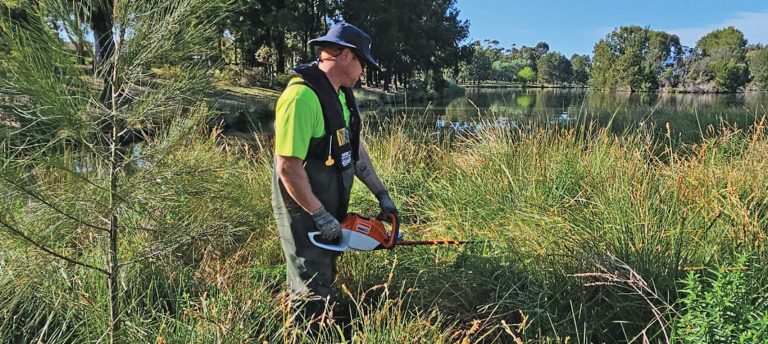
Routine maintenance provides an opportunity for stormwater technicians to remedy issues before they lead to performance impacts or costly repairs. Scheduled maintenance includes assessing damage after extreme weather, monitoring anchoring systems, and observing potential environmental impacts, such as tidal flows.
Litter removal should be performed on a regular basis (e.g. 6 months), but is guided by visual inspections. Storm events often deliver a significant debris load, which may require an immediate response. Depending on the amount of litter captured, it may be removed manually, captured via vacuum truck, or even require heavier equipment (e.g. floating harvester).
Management of weeds on FTW installations is crucial. During the establishment phase of wetland plants, weeds can be removed by hand. After establishment, spot spraying of a selective herbicide is recommended instead.
A key benefit of a modular system is that if plants, media, or weeding fail, the module plant basket may be replaced with a new module, media, and plants, without impacting the overall structure and health of the rest of the FTW system.
On many sites, typical maintenance also includes sediment and litter removal from the inlet pond. Sediment should be removed when it exceeds the maintenance trigger level for the inlet pond or upstream GPT. This may require a bobcat, a small vehicle with a hoist, and a vacuum truck. In larger sites, this may scale up to a long-reach excavator and de-watering equipment.
Our team are experienced in installing, commissioning, and maintaining FTWs, and can help ensure the continued functionality and performance of your stormwater assets.
